
Share of Homes Built on Slabs Surges
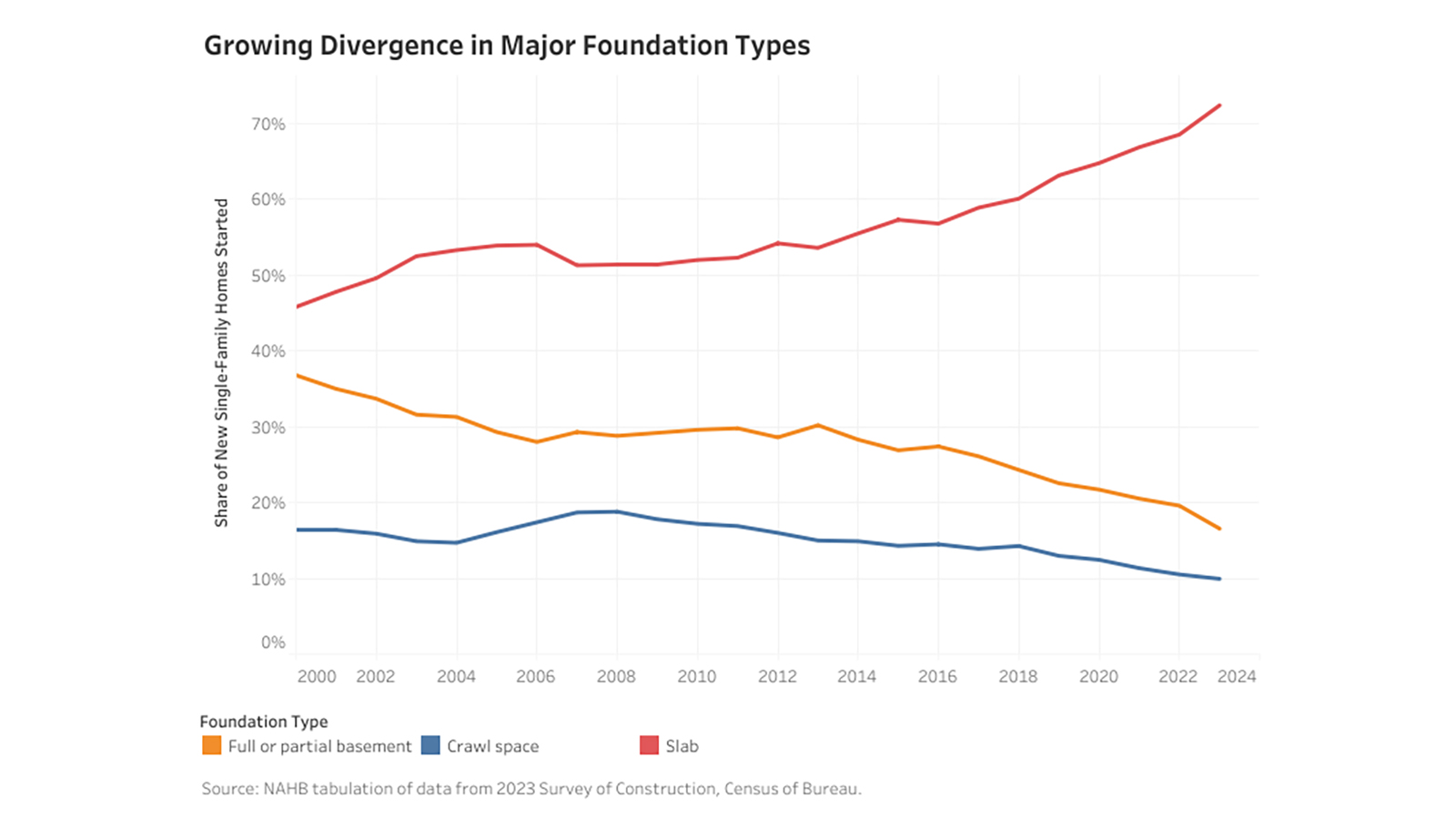
The majority of new single-family homes started in 2023 were built on slab foundations, according to NAHB analysis of the Survey of Construction (SOC). The share of new homes built on slabs has risen steadily from 45.8% in 2000 to 72.4% in 2023. The largest increase occurred from 2022 to 2023, with a jump of 3.9 percentage points, compared to an average increase of 1.93 percentage points over the previous five years.
Conversely, the share of homes with full or partial basements decreased by 3 percentage points from 19.6% in 2022 to 16.6% 2023. Only 9.9% of new single-family homes were built with crawl spaces.

In colder areas where building codes require foundations to be built below the frost line, most homes are constructed with full or partial basements. In the northern divisions, full or partial basement foundations provide additional finished floor areas at a marginal increase of construction cost. The divisions with a majority share of full or partial basements in new homes are West North Central (63.9%), followed by New England (62.1%), Middle Atlantic (48.1%) and East North Central (48%).
In warmer climates where slab foundations are preferred for their cost-effectiveness, new homes with slab foundations are most commonly found in the West South Central (96.9%), Pacific (86.5%), South Atlantic (83.3%) and Mountain (52.9%) divisions.
NAHB Economist Catherine Koh provides more, including interactive graphics, in this Eye on Housing post.
Latest from NAHBNow
Safety
Jun 29, 2026
Use NAHB Resources to Protect Workers from Heat and UV ExposureAs NAHB recognizes UV Safety Awareness Month in July, it is important for home builders and general contractors to educate workers about the potential risks associated with ultraviolet (UV) radiation and have plans and resources in place to keep them safe on the jobsite.
Advocacy
Jun 29, 2026
From Builder to Elected Official: How to Run for Office with ConfidenceNAHB’s election guidebook program can help NAHB members and industry leaders who are thinking about running for office lead effective state or local campaigns.
Latest Economic News
Economics
Jun 30, 2026
Construction Job Openings IncreaseThe number of open positions in the construction sector increased in May, per the Bureau of Labor Statistics Job Openings and Labor Turnover Survey (JOLTS). The current level of open jobs is down measurably from three years ago due to declines in construction activity, particularly in housing.
Economics
Jun 26, 2026
Property Tax Revenue Leads State and Local Tax Growth in Q1 2026Property tax revenue collected by state and local governments was higher in the first quarter of 2026 according to the Census Bureau’s quarterly summary of state and local tax revenue.
Economics
Jun 25, 2026
State-Level Economic Growth Strengthened in the First Quarter of 2026State economic growth strengthened in the first quarter of 2026, with real GDP increasing in 46 states and the District of Columbia. According to the Bureau of Economic Analysis (BEA), state-level growth rates ranged from a 4.5% annualized increase in Washington to a 1.6% decline in South Dakota, while Delaware’s economy was essentially unchanged during the quarter.